

Eccentric Exercise: The Strength Most People Rush Through
The most overlooked part of strength is not the lift. It is the lowering.

Most people think strength lives in the upward motion.
The squat counts when you stand.
The push-up counts when you press.
The curl counts when the weight comes up.
But the body keeps score somewhere else too.
In the descent.
In the braking.
In the moment gravity pulls and the body refuses to collapse.
That is eccentric exercise.
A muscle works while it lengthens.
You lower into a chair. You walk downstairs. You land from a jump. You lower a dumbbell instead of letting it fall. The muscle is not resting. It is resisting. Eccentric contractions involve the muscle-tendon unit lengthening while producing force, which gives them distinct mechanical and physiological features.
This is not a minor detail.
It is the difference between force and control.
And control is where much of real-world strength begins.

Your body does not only need an engine. It needs brakes.
Modern fitness sells acceleration.
Lift more.
Run faster.
Push harder.
Do more.
But life is not only acceleration.
Life is also deceleration.
You need braking strength when you miss a step. When you walk downhill. When your knee absorbs impact. When you lower yourself to the floor. When your body has to stop momentum before momentum becomes injury.
This is why eccentric exercise deserves more attention.
Eccentric muscle actions can produce high force with lower energy cost than concentric actions, which helps explain their use in rehabilitation, aging, and performance training.
But the real point is simpler.
The body does not fail only because it cannot produce force.
It also fails because it cannot control force.

The lowering phase is not empty space between repetitions.
Most people waste half the rep.
They lift with attention.
Then they drop with habit.
That is the mistake.
The descent is not filler. It is feedback.
When you lower into a squat, the body has to manage load through range. When you lower a weight, the muscle has to resist gravity. When you step down from a stair, the quadriceps help prevent the knee from giving way.
This is useful training.
A classic systematic review found eccentric training can support greater gains in strength and muscle mass compared with concentric training in healthy adults, depending on how the training is designed. A later systematic review also described eccentric training as a strong stimulus for muscle function and muscle-tendon adaptations.
The lesson is not complicated.
Do not rush the part of the movement where the body learns control.

This is not only for athletes.
Eccentric training sounds like something built for elite sport.
It is not.
Athletes need it because sprinting, cutting, jumping, and landing punish poor braking strength. But ordinary life asks for the same quality in quieter ways.
You need eccentric strength to:
sit down without dropping;
go downstairs with control;
slow your body after a stumble;
carry bags down steps;
lower yourself to the ground;
hike downhill without angry knees;
absorb impact when walking, running, or changing direction.
This is where the conversation becomes more practical.
For older adults, eccentric resistance training has become a serious area of interest because it may improve strength and function while using a lower energy cost for a given force. A 2025 systematic review and meta-analysis in healthy older adults found a small but significant strength advantage for eccentric resistance training compared with traditional resistance training, while both approaches improved function.
That matters.
Aging does not remove the need for strength.
It raises the price of poor control.

Tendons do not respond well to panic; they respond to load.
Tendon problems are rarely solved by avoiding all stress.
They are also rarely solved by attacking the tissue with random intensity.
Tendons need a better message.
Enough load to stimulate adaptation.
Enough time to recover.
Enough patience to repeat.
That is why eccentric exercise became so prominent in tendon rehabilitation, especially for Achilles and patellar tendinopathy. Eccentric exercise has been the most common and consistently effective exercise approach across tendinopathy reviews.
But this is where the nuance matters.
Eccentric training is useful.
It is not magic.
In midportion Achilles tendinopathy, for example, heavy slow resistance and eccentric training have both shown lasting clinical benefit. A 2023 systematic review and meta-analysis also examined eccentric exercise for midportion Achilles tendinopathy, reinforcing that loading-based care remains central, even though not every comparison favors eccentric work alone.
The better message is not:
“Do eccentric exercise for tendon pain.”
The better message is:
Tendons need load they can adapt to.
Eccentric work is one way to deliver that load.
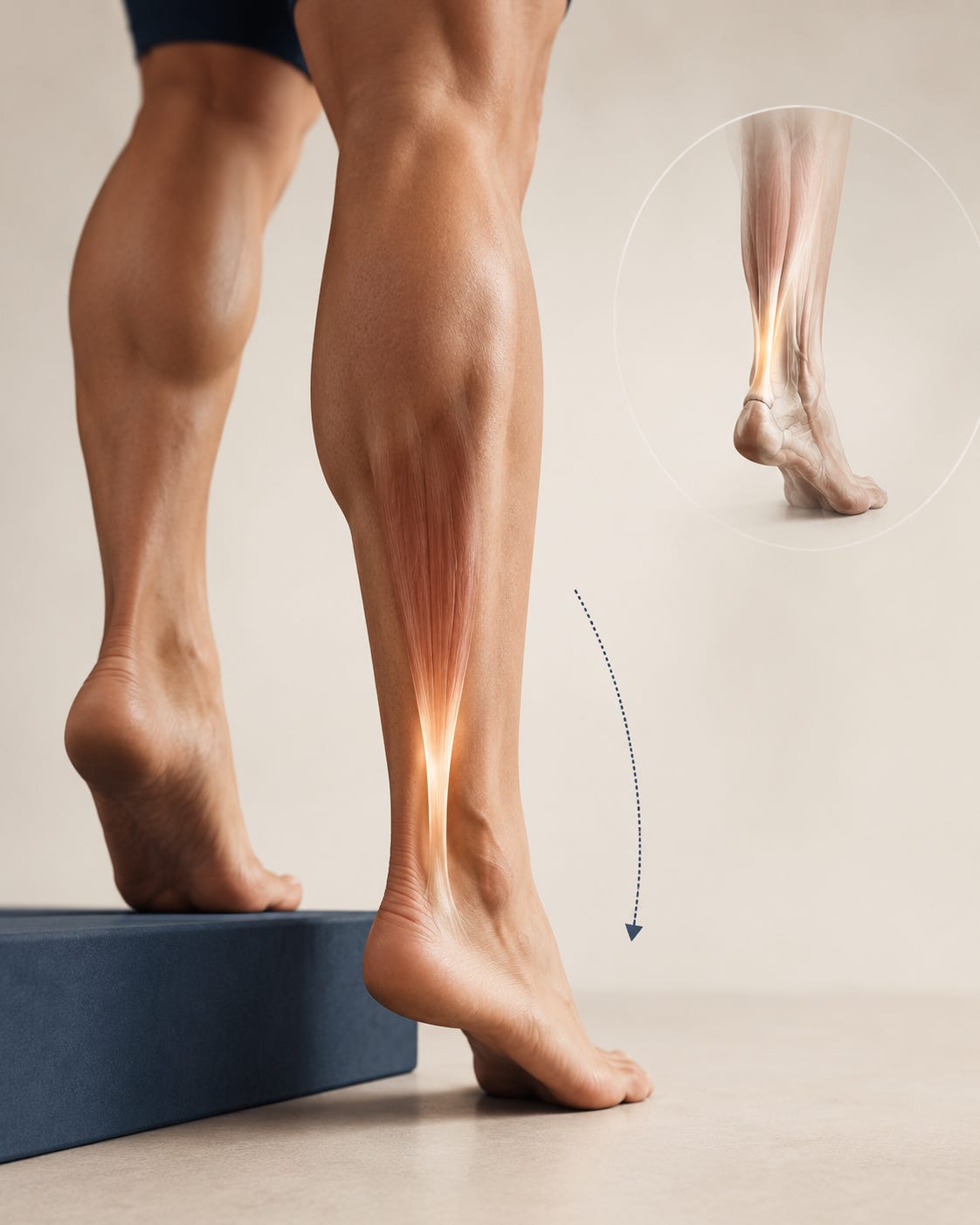
Soreness is a signal, not a trophy.
Eccentric exercise has a reputation for soreness.
That reputation is deserved.
Unfamiliar eccentric work can cause delayed-onset muscle soreness, temporary strength loss, stiffness, and muscle damage markers.
But soreness is not the goal.
This is where many people misread the body.
They assume soreness means progress.
They assume no soreness means failure.
They turn discomfort into proof.
That is poor interpretation.
A good eccentric program does not chase soreness. It builds tolerance.
The repeated bout effect shows that after an initial eccentric exposure, the body can experience less soreness and less disruption from a later similar bout.
That is the hidden advantage.
You do not need to shock the tissue.
You need to teach it.
For muscle growth, eccentric training matters, but it should not become a religion.
The internet likes clean claims.
“Eccentrics build more muscle.”
“Slow negatives are superior.”
“Lowering is the secret.”
The evidence is more useful than that.
A 2017 systematic review and meta-analysis found a greater effect for eccentric actions on hypertrophy, but the difference between eccentric and concentric actions did not reach statistical significance.
That should change how we talk about this.
Eccentric training is valuable.
Concentric training is valuable.
The full repetition matters.
For muscle growth, the body still needs enough tension, enough volume, enough recovery, and enough consistency. The lowering phase can strengthen the signal, but it does not replace the rest of the equation.
The point is not to worship the eccentric.
The point is to stop wasting it.
For injury prevention, the strongest lesson comes from the hamstrings.
The hamstrings reveal the value of eccentric strength with unusual clarity.
High-speed running places the hamstrings under heavy force while they lengthen. That is exactly where eccentric capacity matters.
This is why the Nordic hamstring exercise became famous in sport.
A major systematic review and meta-analysis found that injury prevention programs including the Nordic hamstring exercise reduced hamstring injuries by up to 51%.
That does not mean every person needs Nordic hamstrings.

For many beginners, they are too aggressive.
But the principle travels well:
Train the body to handle force while lengthening.
That principle applies to stairs.
To downhill walking.
To landing.
To balance recovery.
To aging.
To sport.
Eccentric strength is not a trick.
It is a form of protection.
The easiest upgrade is not more weight. It is more control.
Most people make exercise harder by adding load.
That can work.
But a cleaner first step is to add control.
Before adding weight, slow the lowering phase.
Try this:
lower into a squat over 3 seconds;
lower your heel from a calf raise over 3–4 seconds;
lower your chest in an incline push-up over 3 seconds;
lower a dumbbell with control instead of dropping it;
step down from a low step without letting the knee collapse.
This changes the exercise without turning it into a spectacle.
Same movement.
Better signal.
Adults are advised to perform muscle-strengthening activities for major muscle groups at least two days per week, alongside regular physical activity. Eccentric training can fit inside that recommendation as a controlled layer of resistance work, not as a separate fitness identity.
The best program is not the one that looks intense.
It is the one the body can repeat, absorb, and build from.
A smart beginner plan should feel almost too easy.
The first eccentric session should not impress you.
That is the point.
Eccentric work has delayed costs. The session may feel manageable today and speak louder tomorrow. That is why the first dose should be conservative.
Start with 2–3 exercises.
Use control.
Avoid strain.
Stop before form breaks.
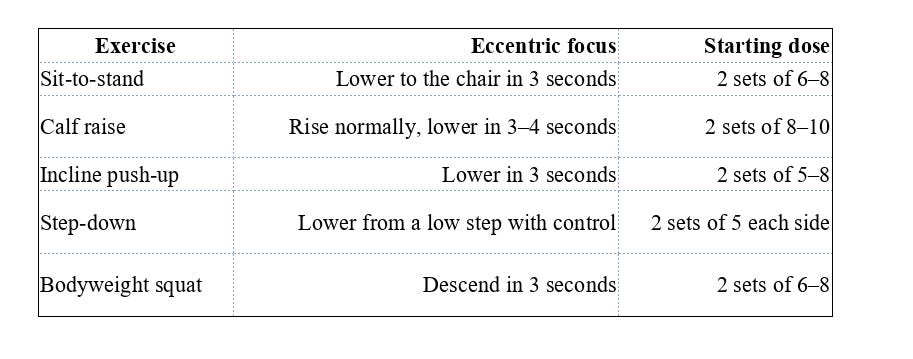
Keep the first week light.
If soreness lasts more than two or three days, reduce the dose.
If joints feel irritated, shorten the range.
If tendon pain is present, progress with professional guidance.
Eccentric training rewards restraint.
The body adapts better when it does not have to defend itself from your ambition.
The deeper lesson is not about technique.
Eccentric exercise teaches a larger truth about strength.
Strength is not only what you can lift.
It is what you can lower.
What you can absorb.
What you can stop.
What you can control when gravity gets involved.
That is why the lowering phase deserves more respect.
Many people train the part of movement that looks powerful and ignore the part that keeps them capable.
But the body knows the difference.
Power gets attention.
Control keeps you moving.
And sometimes, the part of the movement people rush through is the part their body needed most.
References
American College of Sports Medicine. (2009). Progression models in resistance training for healthy adults. Medicine & Science in Sports & Exercise, 41(3), 687–708. https://doi.org/10.1249/MSS.0b013e3181915670
Beyer, R., Kongsgaard, M., Hougs Kjær, B., Øhlenschlæger, T., Kjær, M., & Magnusson, S. P. (2015). Heavy slow resistance versus eccentric training as treatment for Achilles tendinopathy: A randomized controlled trial. The American Journal of Sports Medicine, 43(7), 1704–1711. https://doi.org/10.1177/0363546515584760
Chaabene, H., Müller, P., Dhahbi, W., Königstein, K., Taubert, M., Markov, A., & Lehmann, N. (2026). The effects of eccentric versus traditional resistance training on muscle strength, power, hypertrophy, and functional performance in older adults: A systematic review with multilevel meta-analysis of randomized controlled trials. Ageing Research Reviews, 113, Article 102933. https://doi.org/10.1016/j.arr.2025.102933
Douglas, J., Pearson, S., Ross, A., & McGuigan, M. (2017). Chronic adaptations to eccentric training: A systematic review. Sports Medicine, 47(5), 917–941. https://doi.org/10.1007/s40279-016-0628-4
Hody, S., Croisier, J.-L., Bury, T., Rogister, B., & Leprince, P. (2019). Eccentric muscle contractions: Risks and benefits. Frontiers in Physiology, 10, Article 536. https://doi.org/10.3389/fphys.2019.00536
Irby, A., Gutierrez, J., Chamberlin, C., Thomas, S. J., & Rosen, A. B. (2020). Clinical management of tendinopathy: A systematic review of systematic reviews evaluating the effectiveness of tendinopathy treatments. Scandinavian Journal of Medicine & Science in Sports, 30(10), 1810–1826. https://doi.org/10.1111/sms.13734
Isner-Horobeti, M.-E., Dufour, S. P., Vautravers, P., Geny, B., Coudeyre, E., & Richard, R. (2013). Eccentric exercise training: Modalities, applications and perspectives. Sports Medicine, 43(6), 483–512. https://doi.org/10.1007/s40279-013-0052-y
Prudêncio, D. A., Maffulli, N., Migliorini, F., Serafim, T. T., Nunes, L. F., Sanada, L. S., & Okubo, R. (2023). Eccentric exercise is more effective than other exercises in the treatment of mid-portion Achilles tendinopathy: Systematic review and meta-analysis. BMC Sports Science, Medicine and Rehabilitation, 15, Article 9. https://doi.org/10.1186/s13102-023-00618-2
Roig, M., O’Brien, K., Kirk, G., Murray, R., McKinnon, P., Shadgan, B., & Reid, W. D. (2009). The effects of eccentric versus concentric resistance training on muscle strength and mass in healthy adults: A systematic review with meta-analysis. British Journal of Sports Medicine, 43(8), 556–568. https://doi.org/10.1136/bjsm.2008.051417
Schoenfeld, B. J., Ogborn, D. I., Vigotsky, A. D., Franchi, M. V., & Krieger, J. W. (2017). Hypertrophic effects of concentric vs. eccentric muscle actions: A systematic review and meta-analysis. Journal of Strength and Conditioning Research, 31(9), 2599–2608. https://doi.org/10.1519/JSC.0000000000001983
van Dyk, N., Behan, F. P., & Whiteley, R. (2019). Including the Nordic hamstring exercise in injury prevention programmes halves the rate of hamstring injuries: A systematic review and meta-analysis of 8459 athletes. British Journal of Sports Medicine, 53(21), 1362–1370. https://doi.org/10.1136/bjsports-2018-100045
World Health Organization. (2020). WHO guidelines on physical activity and sedentary behaviour. World Health Organization. https://www.who.int/publications/i/item/9789240015128