

Make Something. Then Do Nothing. The Dual Engine of Creative Health
The Role of Creativity in a Burned-Out World


If your mind feels like a crowded subway, you don’t need another app.
You need two simple practices: make something and do nothing.
Creative leisure and creative idleness are different gears that, together, lift mood, sharpen thinking, and sustain productivity over time.
What they are
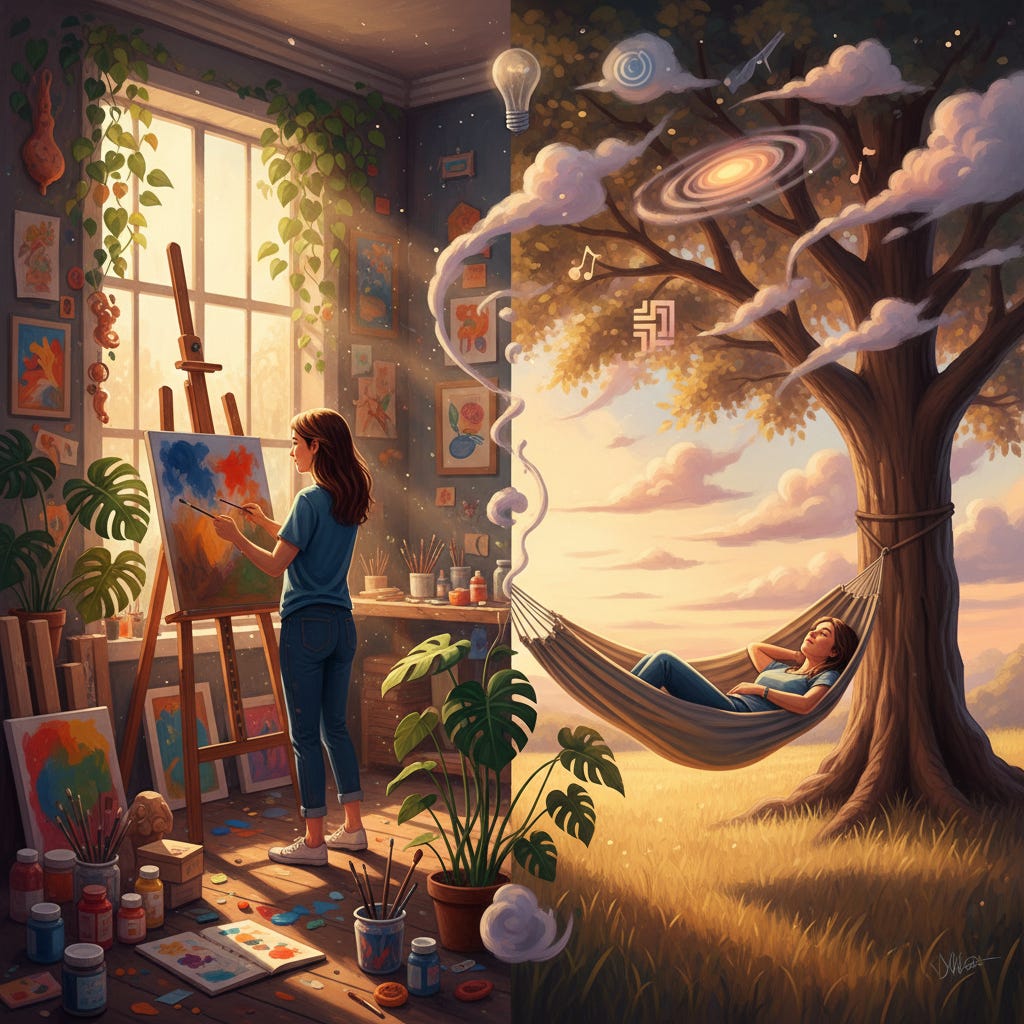
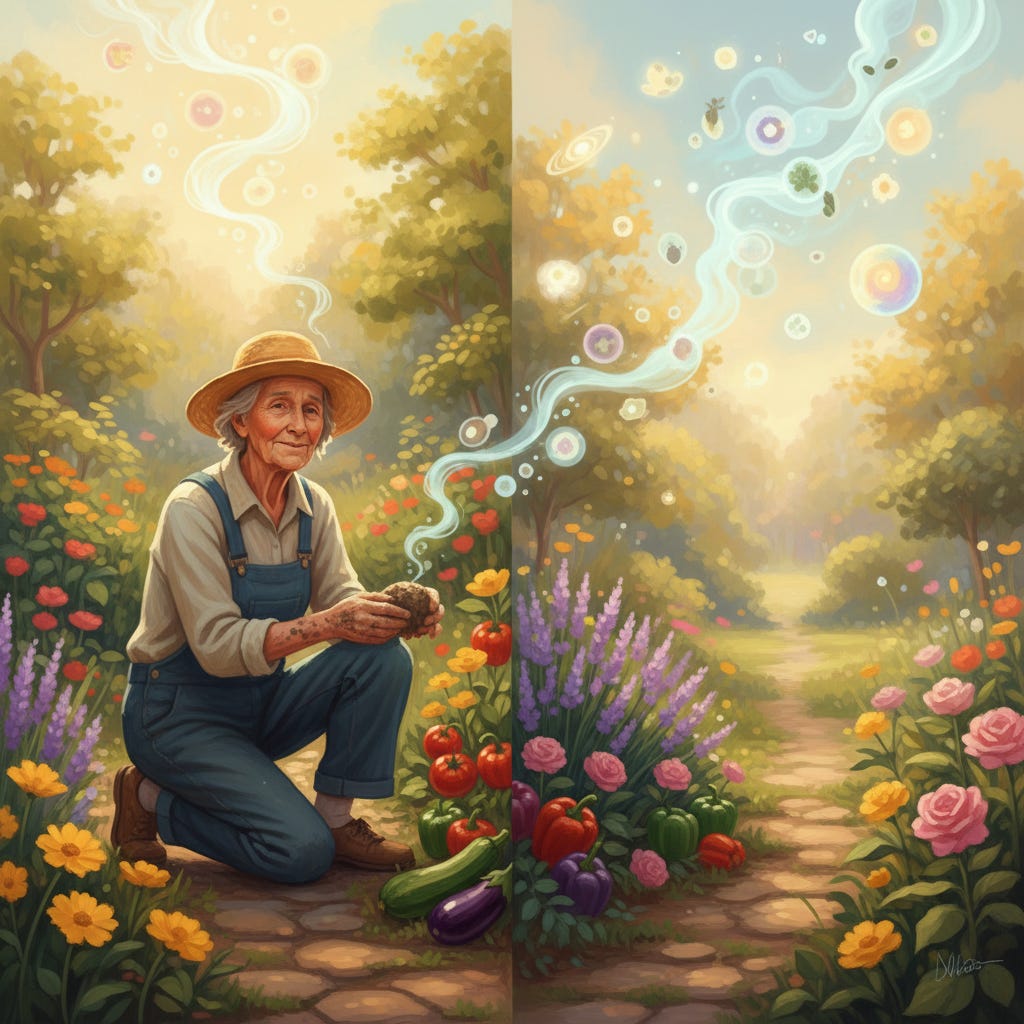
Creative leisure: active, hands-on hobbies in your free time: arts, crafts, writing, gardening. It builds skill, expression, and momentum.
Creative idleness: passive mental rest: mind-wandering and low-stimulation downtime that lets your brain form novel associations without effort.
Mental Health Benefits
Large cohorts and COVID-era fixed-effects panels link creative leisure to higher life satisfaction, happiness, and feeling life is worthwhile, alongside fewer depressive symptoms, especially via crafting and gardening.
Systematic reviews in adults 50+ show arts reduce loneliness and improve quality of life.
Cognition and aging
Prospective cohorts following people for ~6 years connect mind-stimulating hobbies with better daily functioning, reduced cognitive impairment, and longer, healthier lives.
In older adults, creative activity enhances cognition, with education amplifying effects. Think of it as light, frequent brain reps.
Creative Idleness and Ideas
Experience-sampling studies find highly creative people have more dynamic, engaged idle thoughts, and daily diary research shows that psychologically detaching from work fosters next-day creativity, moderated by job resources.
In plain English: boredom plus breathing room sparks non-obvious connections.
Productivity
Direct trials on productivity are thin.
But the pattern is consistent:
Creative leisure stabilizes mood, purpose, and social bonds under stress;
Creative idleness fuels radical ideation.
Together, they support sustained performance, especially during volatile periods. Higher-level trials will sharpen causality, but you don’t need to wait to feel the gains.
Simple model: Two gears, one engine
Gear 1: Make. Hands-on creation shifts attention away from rumination, delivers micro-wins, and builds confidence.
Gear 2: Drift. Low-input idle time invites associative thinking, reframes problems, and surfaces fresher angles.
Receipts at a glance
Well-being: cohorts and fixed-effects panels show higher life satisfaction and lower depressive symptoms; over-50 reviews add reduced loneliness.
Cognition/aging: 6-year cohorts link hobbies to function, lower impairment, and longevity; education strengthens effects.
Productivity: early but suggestive: resilience and purpose via leisure; next-day creativity via detachment and idleness. More trials needed.
Closing Thought
Most people try to think their way out of burnout.
Better path: touch materials, then touch nothing.
Make something.
Then do nothing.
Let those two gears carry you.
References
Bone, J. K., Fancourt, D., Sonke, J. K., Fluharty, M. E., Cohen, R., Lee, J. B., Kolenic, A. J., Radunovich, H., & Bu, F. (2023). Creative leisure activities, mental health and well-being during 5 months of the COVID-19 pandemic: a fixed effects analysis of data from 3725 US adults. Journal of epidemiology and community health, 77(5), 293–297. https://doi.org/10.1136/jech-2022-219653
Fassi J. (2023). CREATIVE ACTIVITIES AND COGNITION AMONG OLDER ADULTS: DOES EDUCATION MODERATE THE BENEFITS OF CREATIVE ACTIVITIES?. Innovation in Aging, 7(Suppl 1), 1013. https://doi.org/10.1093/geroni/igad104.3254
Keyes, H., Gradidge, S., Forwood, S. E., Gibson, N., Harvey, A., Kis, E., Mutsatsa, K., Ownsworth, R., Roeloffs, S., & Zawisza, M. (2024). Creating arts and crafting positively predicts subjective wellbeing. Frontiers in public health, 12, 1417997. https://doi.org/10.3389/fpubh.2024.1417997
Morse, K. F., Fine, P. A., & Friedlander, K. J. (2021). Creativity and Leisure During COVID-19: Examining the Relationship Between Leisure Activities, Motivations, and Psychological Well-Being. Frontiers in psychology, 12, 609967. https://doi.org/10.3389/fpsyg.2021.609967
O’Sullivan, R., & McQuade, L. (2022). ARTS AND CREATIVITY AND THEIR IMPACT ON HEALTH AND WELL-BEING: A SYSTEMATIC REVIEW OF THE EVIDENCE. Innovation in Aging, 6(Suppl 1), 212. https://doi.org/10.1093/geroni/igac059.846
Weziak-Bialowolska, D., Bialowolski, P., & Sacco, P. L. (2023). Mind-stimulating leisure activities: Prospective associations with health, wellbeing, and longevity. Frontiers in public health, 11, 1117822. https://doi.org/10.3389/fpubh.2023.1117822